Agnes Knudsdatter
The ChangelingAgnes Knudsdatter is the first child in Queens borough whom the Knudsen family abandoned to a Troll, and the founding loss behind the family history Apollo Kagwa uncovers. Born during her parents’ voyage from Norway, she was taken into the woods by her father, Nils Knudsen, and left in a cave as payment for the protection he had secured. Her brief, largely remembered life gives the family’s inherited bargain its human scale: it is not an abstract pact, but a father’s decision to surrender his daughter and a mother’s refusal to believe she is gone.
Identity and Family Background
Agnes was born aboard the Restoration, the sloop on which Nils and Anna Sofie travelled to America. They had been married for four years when they boarded. Anna Sofie was already pregnant, and she gave birth during the voyage. Agnes’s birth therefore belongs to the family’s migration story, but her life in the new country was short: when Apollo asks why she does not appear in a later family picture, Jorgen Knudsen explains that she was already dead by then.
The loss altered the family that remained. Anna Sofie never recovered from Agnes’s death. Nils eventually remarried Petra Mikkelsdatter, while Anna Sofie went into the forest because she believed her daughter was somewhere out there and wanted to find her. The contrast is stark: Nils had been the person who carried Agnes into the woods and left her there, while Anna Sofie continued to search for the child she had lost. The evidence does not give the circumstances of Agnes’s death beyond the abandonment, but it establishes that her disappearance continued to shape her mother’s life.
The Abandonment and the Family Pact
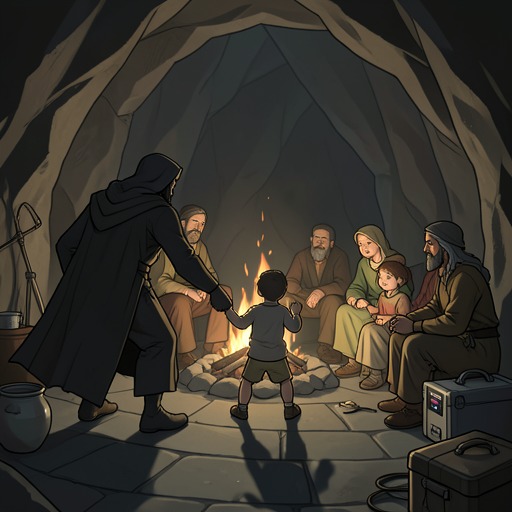
Jorgen’s account places Agnes’s fate within a bargain Nils made in Norway. Nils needed passage for Anna Sofie and, according to Jorgen, had doubts about the small sloop on which they planned to sail. He brought a Troll as insurance. The agreement required him to serve as its caretaker and appease it; the price it demanded was a child. When he could no longer delay, Nils took Agnes out into the woods and delivered her to the creature’s cave.
This disclosure changes the meaning of the family’s history. Agnes was not simply a child who died during migration: her father deliberately made her the payment that secured the family’s arrangement with the Troll. Jorgen’s restrained explanation makes the betrayal more disturbing, not less. Apollo’s response is physical and immediate: after hearing that Nils left Agnes in the cave, he stares at the utility knife in his hand, and Jorgen presses it back down. The scene registers how the inherited account moves from family lore into present danger for the person hearing it.
The cave remains central to the story long after Agnes’s abandonment. Apollo later recognizes a computer image as the cave and learns that Kinder Garten has placed a camera there. That later surveillance does not restore Agnes or resolve the circumstances of her death. Instead, it shows that the cave persists as a site tied to the family’s inheritance, where old violence and present efforts to observe or control events meet.
A Child Recovered Through Memory
Agnes survives in the family’s record as a drawn likeness rather than a living memory shared directly with Apollo. Jorgen points to a sketch made by his own father much later, from memory. It shows a very young child, with closed eyes and wisps of hair. The image is slight, but its place in the room gives it weight: Apollo sees it beside a wall whose windows have been removed and which is covered with portraits of children.
The portraits form a visual history. They begin with sketches and charcoal drawings, move through daguerreotypes and black-and-white photographs, and continue into early color images. The subjects are infants, none older than a year. Agnes’s remembered likeness thus sits within a much larger sequence of children, making her both an individual loss and the earliest visible point in a recurring family horror. Apollo’s perception of the altered wall as a wavering line of pictures reinforces the instability of this archive: the children are preserved as images, while the history that explains their presence has been hidden or withheld.
Later, among bones near the cave, Apollo holds a skull and decides it belonged to Agnes, the first abandoned child in Queens borough. The identification is his conclusion, not a confirmation from another character. When he looks again, the skull seems only like a gray rock; the moment makes the possibility of recognition inseparable from the novel’s concern with glamour, which can obscure suffering. Agnes’s remains are not securely identified, but Apollo’s attempt to name them shows how urgently he wants the family’s first abandoned child to be more than an erased face.
Folktale Echoes and Narrative Significance
The novel places Agnes’s history alongside stories in which children are surrendered, hidden, or endangered. In Emma Valentine’s retelling of Rapunzel, a couple’s desire for food and a child ends in a bargain with an enchantress, who takes their baby and hides her away. The story eventually gives Rapunzel a reunion and a return to family life; Agnes’s known history offers no such recovery. The contrast makes the familiar promise of a fairy-tale ending feel uncertain beside the family’s actual choices and losses.
A second embedded tale, told by an old man confronting Apollo, follows Askeladden, the youngest son of a poor farmer. A Troll chops down the forest through the night and turns to stone when daylight arrives. That tale gives folkloric form to the Troll’s vulnerability to sunlight, but it also stands apart from Agnes’s story: its boy survives, the family gains wealth, and the ending restores fortune. Agnes, by contrast, is the child whose abandonment makes another family’s security possible. The difference between the tales’ endings and her fate underscores how easily a consoling story can conceal the cost imposed on a child.
Agnes is therefore significant less for a long sequence of actions than for the relations and absences organized around her. She is Nils’s daughter, Anna Sofie’s lost child, the subject of a belated portrait, and the first known victim of the Knudsen–Troll bargain. Her mother’s search, Jorgen’s confession, the procession of infant portraits, and Apollo’s uncertain identification of a skull all return the narrative to the same question of what a family chooses to remember. Agnes’s brief life exposes the pact’s origin and its price; the story preserves her not through a recovered biography, but through the consequences of what was done to her.